APRIL QIU CHENG.
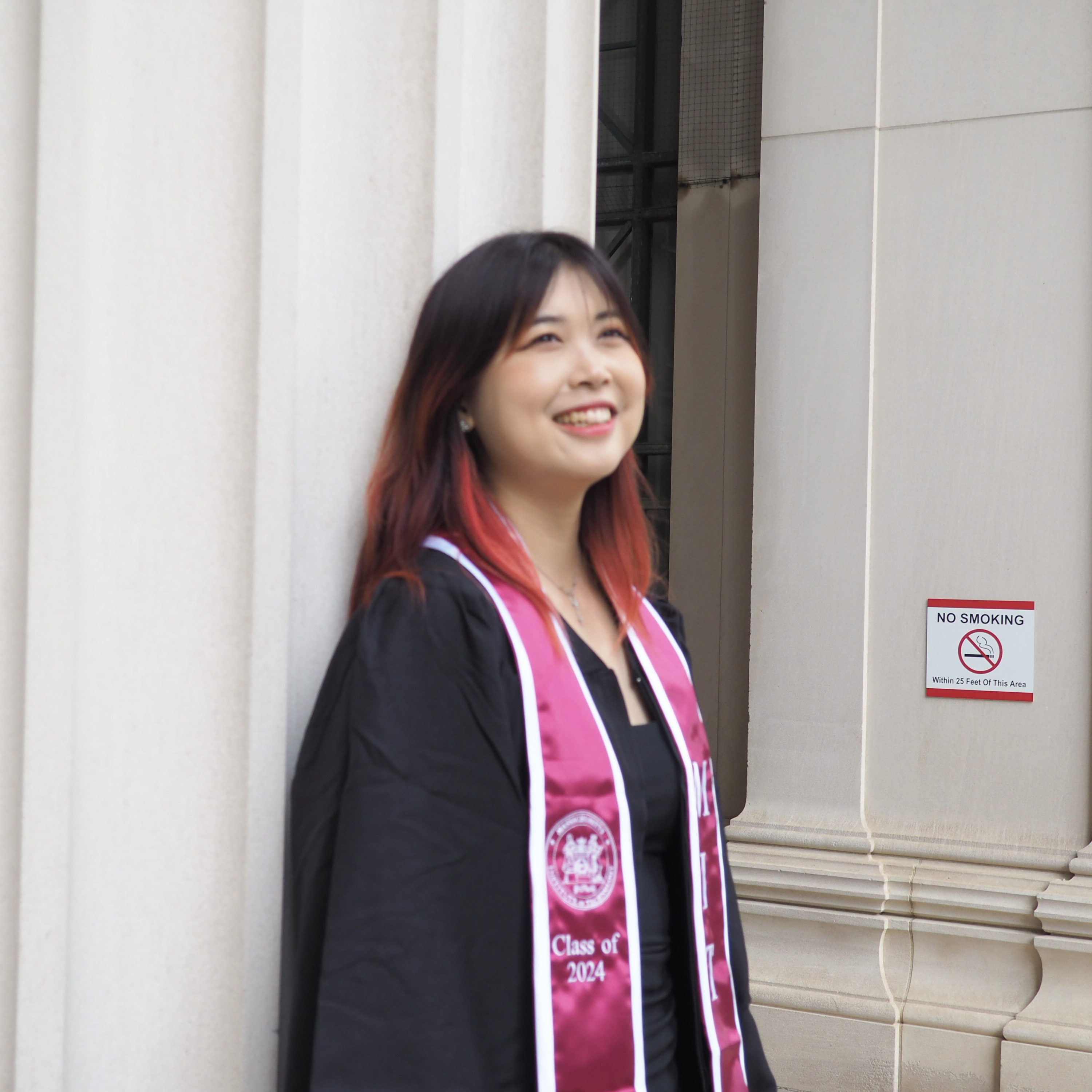
I completed my undergraduate studies in physics and mathematics at MIT in 2024, after which I completed a Fulbright research fellowship at the Albert Einstein Institute in Potsdam. I'm a 2025 Hertz fellow, 2023 Astronaut Scholar, and the winner of the 2024 MIT Barrett Prize. In 2024, I attended the 73rd Lindau Nobel Laureate Meeting. I began my PhD at Princeton in fall 2025.
In my free time, I like to write, read, try new cafés, and play video games.
selected research (click to expand!)
>
Using GWTC-4 data, we performed the first data-driven search for subpopulations using reversible-jump MCMC and a novel flexible parameterized population model. We find three subpopulations, two of which we interpret as isolated and dynamical formation channels, despite making no prior astrophysical assumptions. Generally, we reproduce previously found subpopulations in the data without targeting those features. We also find the first data-driven evidence of different subpopulations in redshift, and discuss its astrophysical implications.
>
This is a rigorous and pedagogical introduction to cross-correlations with gravitational wave sources. I present a unified framework for cosmology with gravitational waves, showing that cross-correlating gravitational wave sources with galaxies is an extension of the canonical "galaxy catalog method" that the LVK uses that efficiently leverages Gaussian 2-point statistics, at the cost of approximations that require large numbers of well-localized events. Using this formalism, I also show the first self-consistent demonstration of the cross-correlation of gravitational wave sources with noise in a full Bayesian inference setting.
>
I built the first library to simulate full-sky fast radio bursts (FRBs) by ray tracing through the Illustris-TNG cosmological simulation. I ran a variety of experiments to study systematics and selection effects in cross-correlations of FRB dispersion measures and foreground galaxies as a cosmological probe.
>
Using astrophysically-motivated models to infer the formation origins of binary black holes (Zevin+ 2021), I updated the analysis with GWTC-3, made forecasts for GWTC-4, and explicitly showed the biases that arise from wrong or incomplete prior astrophysical knowledge.
For a complete list of my publications, including talks and non-refereed works, see my ADS.
outreach
The road ahead is long, but so is my journey thus far. In high school, I participated in the International Olympiad for Astronomy and Astrophysics and Science Olympiad. Without these outreach programs, I wouldn't be where I am.
Since 2020, I have been heavily involved in writing astronomy tests and developing resources for the Astronomy event of Science Olympiad. A (nearly) comprehensive list of these can be found here. In 2025, I was also involved in coaching the USA IOAA team.
As of Spring 2026, I teach astronomy at the New Jersey Northern State Prison as part of the Prison Teaching Initiative.
Other outreach involvements are in the works...
>
Using GWTC-4 data, we performed the first data-driven search for subpopulations using reversible-jump MCMC and a novel flexible parameterized population model. We find three subpopulations, two of which we interpret as isolated and dynamical formation channels, despite making no prior astrophysical assumptions. Generally, we reproduce previously found subpopulations in the data without targeting those features. We also find the first data-driven evidence of different subpopulations in redshift, and discuss its astrophysical implications.
>
This is a rigorous and pedagogical introduction to cross-correlations with gravitational wave sources. I present a unified framework for cosmology with gravitational waves, showing that cross-correlating gravitational wave sources with galaxies is an extension of the canonical "galaxy catalog method" that the LVK uses that efficiently leverages Gaussian 2-point statistics, at the cost of approximations that require large numbers of well-localized events. Using this formalism, I also show the first self-consistent demonstration of the cross-correlation of gravitational wave sources with noise in a full Bayesian inference setting.
>
I built the first library to simulate full-sky fast radio bursts (FRBs) by ray tracing through the Illustris-TNG cosmological simulation. I ran a variety of experiments to study systematics and selection effects in cross-correlations of FRB dispersion measures and foreground galaxies as a cosmological probe.
>
Using astrophysically-motivated models to infer the formation origins of binary black holes (Zevin+ 2021), I updated the analysis with GWTC-3, made forecasts for GWTC-4, and explicitly showed the biases that arise from wrong or incomplete prior astrophysical knowledge.
The road ahead is long, but so is my journey thus far. In high school, I participated in the International Olympiad for Astronomy and Astrophysics and Science Olympiad. Without these outreach programs, I wouldn't be where I am.
Since 2020, I have been heavily involved in writing astronomy tests and developing resources for the Astronomy event of Science Olympiad. A (nearly) comprehensive list of these can be found here. In 2025, I was also involved in coaching the USA IOAA team.
As of Spring 2026, I teach astronomy at the New Jersey Northern State Prison as part of the Prison Teaching Initiative.
Other outreach involvements are in the works...